

RUNESILK beard oil guide
Beard Growth Claims: How to Spot Marketing Spin in Beard Oil
Search for beard oil in the UK and you will find plenty of products promising a fuller, thicker or faster-growing beard.
Some claims are direct. Others use vague phrases such as “supports growth” or “maximises your beard's potential” without explaining what the product can realistically achieve.
Beard oil still performs a useful job. It can condition existing facial hair, improve manageability and support the skin beneath the beard. What it cannot do is create new follicles or guarantee faster growth.
Cosmetic beard oil can soften existing hair, support dry-feeling skin and make a beard look better groomed. It cannot create new follicles, permanently increase beard density or guarantee that sparse areas will fill in.
What beard oil can actually do
Beard oil is a leave-in cosmetic product made primarily from carrier oils. Its main purpose is to condition the beard hair and the skin beneath it.
Softens beard hair
A suitable oil can reduce the rough or wiry feel of existing facial hair.
Supports skin comfort
A controlled amount may help ordinarily dry-feeling skin beneath a clean beard.
Improves manageability
Conditioned hair is often easier to comb, arrange and style.
Adds a groomed finish
Beard oil can improve shine and reduce a dull or brittle-looking appearance.
Reduces friction
Oil can provide slip during combing and reduce pulling through coarse hair.
Carries fragrance
Scented beard oil provides a close-wearing fragrance as part of the routine.
These are genuine cosmetic benefits. Beard oil does not need an exaggerated growth promise to be useful.
What beard oil cannot do
A cosmetic beard oil cannot:
- create new facial-hair follicles
- guarantee faster beard growth
- permanently increase follicle density
- rewrite your inherited growth pattern
- provide evidence that it changes the hormonal processes controlling beard growth
- guarantee that sparse areas will fill in
- treat unexplained facial-hair loss
It may make existing hair look fuller by improving softness, shine and styling. That visual improvement should not be confused with new growth.
Read the detailed guide: Does Beard Oil Actually Grow Your Beard? Separating Myth from Reality .
What controls beard growth?
Beard growth is influenced by genetics, age, follicle distribution, hormonal signalling and the way individual follicles respond to androgens.
The biology is more complicated than simply having more or less testosterone. Two people can have very different beard coverage without either having an obvious hormonal problem.
A cosmetic carrier-oil blend cannot change the number or inherited distribution of facial-hair follicles.
Why beard oil can appear to improve growth
Beard oil may create visible changes that are incorrectly interpreted as faster or denser growth.
| Visible change | What may actually be happening |
|---|---|
| The beard looks darker | Conditioned hair may reflect light differently and look less dry |
| The beard looks fuller | Smoother hair may sit together more evenly |
| More length is retained | Conditioning may reduce friction and brittleness during grooming |
| Sparse areas look less obvious | Longer surrounding hairs may become easier to direct and style |
| The beard changes over time | Natural maturation or ordinary growth may have occurred during the same period |
Improved appearance is still a worthwhile result. It simply needs to be described accurately.
Common beard-growth phrases worth questioning
“Promotes beard growth”
This sounds like a direct biological claim. Check whether the brand explains exactly what is meant and what evidence supports it.
Sometimes the intended meaning is only that the oil:
- conditions existing hair
- supports length retention
- reduces a brittle appearance
- helps the beard look healthier
Those are not the same as increasing growth rate or follicle density.
“Supports a fuller-looking beard”
This can be a reasonable cosmetic claim when it refers to better-conditioned hair that sits more neatly.
It becomes questionable when the surrounding copy implies that the product creates new hair without making that claim clearly.
“Activates dormant follicles”
This is a strong physiological claim. A cosmetic beard oil should not make it without appropriate evidence.
“Stimulates circulation for growth”
Warmth, cooling or tingling after application does not prove that a product increases beard growth.
The sensation may instead come from:
- mint
- spice oils
- fragrance concentration
- skin sensitivity
- irritation
“Clinically inspired”
Inspired by clinical science does not mean clinically tested or clinically proven.
Look for clarity about:
- what was tested
- whether the finished product was assessed
- how many people took part
- what outcome was measured
- who conducted the test
Claim language at a glance
| Claim | What it may reasonably mean | What it should not imply without evidence |
|---|---|---|
| Softens | Improves the feel of existing hair | Creates new hair |
| Conditions | Improves surface feel and manageability | Changes follicle biology |
| Fuller-looking | Improves styling or visible appearance | Increases follicle density |
| Supports healthy-looking growth | May refer to conditioned existing hair | Proves faster growth |
| Stimulates growth | A direct biological claim requiring evidence | Ordinary cosmetic conditioning |
| Activates follicles | A strong physiological claim | A conclusion based only on ingredient reputation |
Ingredient studies vs finished-product evidence
One common marketing shortcut is using research about an isolated ingredient to imply that a finished beard oil will produce the same result.
That comparison may be weak when:
- the study used a different concentration
- the ingredient was tested in animals rather than people
- the research involved scalp hair rather than facial hair
- the ingredient was swallowed rather than applied topically
- the study used a laboratory model
- the finished beard oil was never tested
- the product contains only a small amount of the featured ingredient
Research into one botanical ingredient does not automatically prove that every beard oil containing it increases facial-hair growth. Concentration, formulation, test method and the area of the body all matter.
Popular ingredients associated with growth claims
| Ingredient | What it may realistically do | What it does not prove |
|---|---|---|
| Castor Oil | Provides a rich coating and conditioned feel | That new follicles will develop |
| Rosemary Oil | Provides fragrance and wider hair-care interest | Guaranteed beard growth from a finished cosmetic oil |
| Peppermint Oil | Adds cooling fragrance and sensation | That tingling means follicles are being activated |
| Biotin | Has a biological role where a genuine deficiency exists | That extra biotin grows more beard hair in everyone |
| Vitamin E | Can support the cosmetic formula and conditioned feel | Guaranteed facial-hair growth |
| Jojoba and Argan Oils | Support softness, smoothness and manageability | Permanent increases in beard density |
Five signs of responsible beard-oil marketing
- The cosmetic purpose is clear. The product explains whether it is intended for softness, conditioning, manageability, skin comfort or fragrance.
- The complete ingredient list is available. You can see which carrier oils and aromatic ingredients are used.
- The claims are specific. “Helps reduce a rough feel” is more informative than “unlocks your ultimate beard”.
- The evidence matches the claim. Research into one ingredient is not presented as proof that the complete product grows facial hair.
- The limitations are acknowledged. The brand does not guarantee new follicles, faster growth or identical results for everyone.
Why RUNESILK does not promise beard growth
RUNESILK Beard Oil is designed to condition existing facial hair and the skin beneath it.
The carrier-oil approach is built around:
- Grapeseed Oil
- Jojoba Oil
- Argan Oil
- Borage Oil
- Sea Buckthorn Oil
The aim is to support softness, manageability and a groomed finish. The formula is not presented as a medicine or a guaranteed beard-growth treatment.
Read more about the blend: What's in Your Beard Oil? Grapeseed, Jojoba, Argan, Borage and Sea Buckthorn Explained .
Realistic beard care
RUNESILK Beard Oil
Choose RUNESILK Beard Oil for leave-in conditioning, softness, manageability and scent rather than an unsupported promise of new growth.
The collection includes fresh, earthy, woody, spiced, aromatic, resinous and unscented profiles.
Other useful buying signals
Honest claims should remain the priority, but several other details can help you assess a beard-oil brand.
Clear directions
The brand explains how much to use and how to avoid overapplication.
Full product information
Bottle size, ingredients, scent details and warnings are easy to find.
Realistic photography
Before-and-after images are not presented as proof without context.
Fair value comparisons
Bottle size and price can be compared without artificial urgency.
Independent recognition
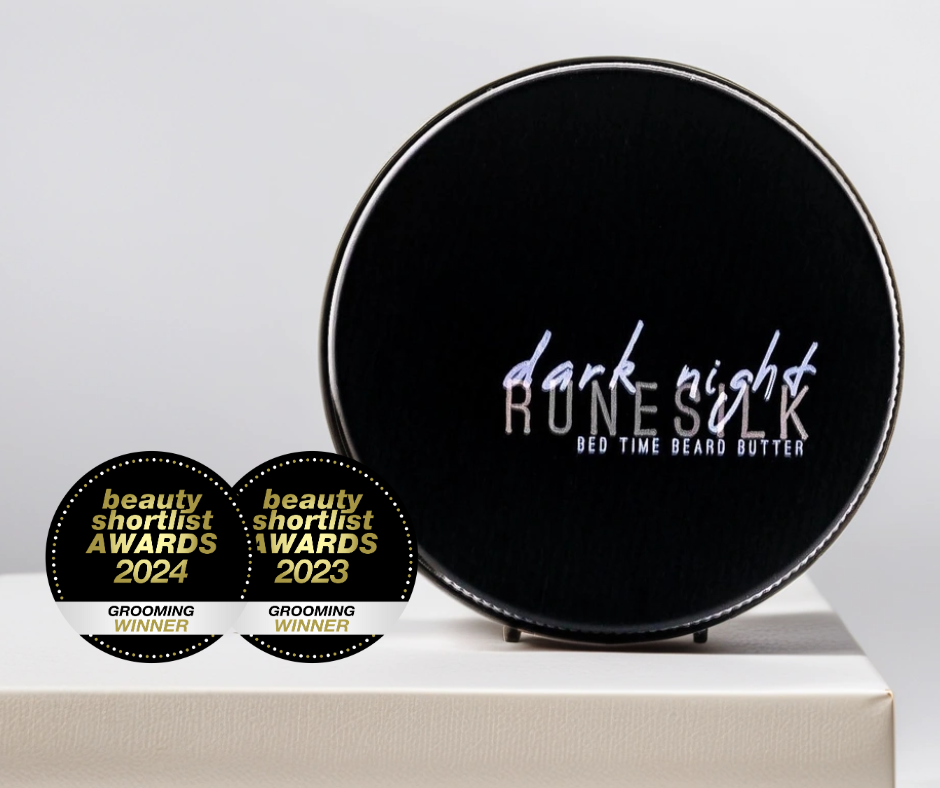
Awards clearly identify the organiser, category and product assessed.
No guaranteed transformations
The brand recognises that beard type, skin and grooming routines differ.
Customer reviews: what they can and cannot prove
Reviews can help you understand:
- scent strength
- texture
- packaging
- how easily the oil spreads
- whether customers found it greasy
- general satisfaction
Reviews do not reliably prove that a product caused new growth.
A reviewer may also have:
- allowed the beard to grow for longer
- changed several products at once
- naturally developed more coverage with age
- changed trimming or styling technique
- interpreted better conditioning as thicker growth
Why before-and-after photos need context
A beard can look dramatically different without any increase in follicle density.
Check whether the images use the same:
- beard length
- lighting
- camera angle
- styling method
- time since trimming
- product finish
Hair fibres, dye, balm and deliberate combing can also change visible fullness.
Marketing pressure and artificial urgency
Growth-focused products are often sold to people who feel insecure about patchy or slow-developing facial hair.
Be cautious when the product page combines growth anxiety with:
- countdown timers that continually reset
- permanent “today only” pricing
- unverified stock warnings
- guaranteed transformations
- claims that waiting will make the problem worse
- pressure to buy several months of product at once
Beard oil is a grooming product. You should have time to compare the formula, price and claims before buying it.
How to assess a beard-oil product page
- Find the main claim. Is the product being sold for cosmetic conditioning or biological growth?
- Read the complete ingredient list. Do not rely only on the ingredients highlighted on the front label.
- Check whether evidence relates to the finished product. An ingredient study is not the same as a product trial.
- Look for measurable wording. Ask what “boosts”, “supports” or “maximises” actually means.
- Review the directions. A trustworthy product should explain how to apply it sensibly.
- Check the bottle size. Compare value per millilitre rather than the headline price alone.
- Look for limitations. Responsible copy should avoid guarantees that a cosmetic oil cannot support.
- Ignore artificial urgency. Take time to compare products properly.
Questions to ask before buying
| Question | Why it matters |
|---|---|
| What is the product actually claiming? | Separates conditioning benefits from implied growth promises |
| Are the carrier oils clearly listed? | Shows what forms most of the formula |
| Was the finished product tested? | Prevents ingredient research being mistaken for product evidence |
| Is the result guaranteed? | Cosmetic performance varies between users |
| What does the bottle contain? | Allows fair price comparison |
| Can I try a sample? | Useful for testing scent and application feel |
| Does the brand acknowledge limitations? | Shows whether the product is being described realistically |
What should you look for instead of a growth promise?
A useful beard oil should be judged by:
- how clearly the carrier blend is disclosed
- how well the oil spreads
- whether it leaves the beard greasy
- how comfortable the scent feels beneath the nose
- whether the beard becomes easier to comb
- whether the skin tolerates the formula
- the bottle size and value
- the quality of the application instructions
Read the complete buying guide: Best Beard Oil UK: An Honest Buying Guide .
How much beard oil should you use?
The right amount is the smallest quantity that conditions the beard without leaving it wet-looking, sticky or heavily coated.
| Beard length | Starting amount | Application focus |
|---|---|---|
| Stubble | 1 to 2 drops | Mostly the skin beneath the growth |
| Short beard | 2 to 3 drops | Skin, roots and short hair |
| Medium beard | 3 to 4 drops | Roots, inner beard and lengths |
| Long beard | Begin with 4 drops | Apply in sections and add gradually |
Read: How Much Beard Oil Should You Actually Use? .
When beard-growth concerns need a different answer
A naturally patchy beard is common and does not automatically indicate a health problem.
Seek suitable professional advice when:
- facial hair disappears suddenly
- round or sharply defined bald patches develop
- the skin becomes painful, inflamed or heavily scaled
- hair loss affects other areas
- a medicine or illness appears connected to the change
- there are other concerning symptoms
Beard oil is not intended to diagnose or treat unexplained hair loss.
Frequently asked questions
Does beard oil make your beard grow faster?
No cosmetic beard oil has been shown to guarantee faster facial-hair growth. Its main purpose is conditioning existing hair and skin.
Can beard oil make a beard look fuller?
Yes. Softer, smoother and better-styled existing hair may create a fuller appearance without increasing the number of follicles.
What does “promotes healthy growth” mean?
It may refer to conditioning, improved appearance or length retention. It should not automatically be interpreted as proof of faster growth.
Can natural oils activate dormant follicles?
Ordinary carrier oils should not be treated as proven follicle-activating medicines.
Does tingling mean beard oil is working?
No. Tingling may come from mint, spice, fragrance strength or irritation. It does not prove increased follicle activity.
Are ingredient studies proof that a beard oil works?
Not necessarily. Check whether the finished product was tested, what concentration was used and whether the research involved facial hair in people.
Are before-and-after photos reliable?
They need context. Beard length, lighting, angle, styling, trimming and time can all change visible fullness.
What should an honest beard oil claim?
It can reasonably describe softness, conditioning, manageability, skin comfort, shine and fragrance without guaranteeing new hair growth.
Why does RUNESILK not promise beard growth?
RUNESILK Beard Oil is designed to condition the beard you already have. It is not presented as a medicine or a guaranteed follicle-growth treatment.
Continue reading the Beard Oil guides
RUNESILK is an independent UK beard-care brand based in Little Paxton, Cambridgeshire. This article provides general cosmetic grooming information and is not medical advice.